
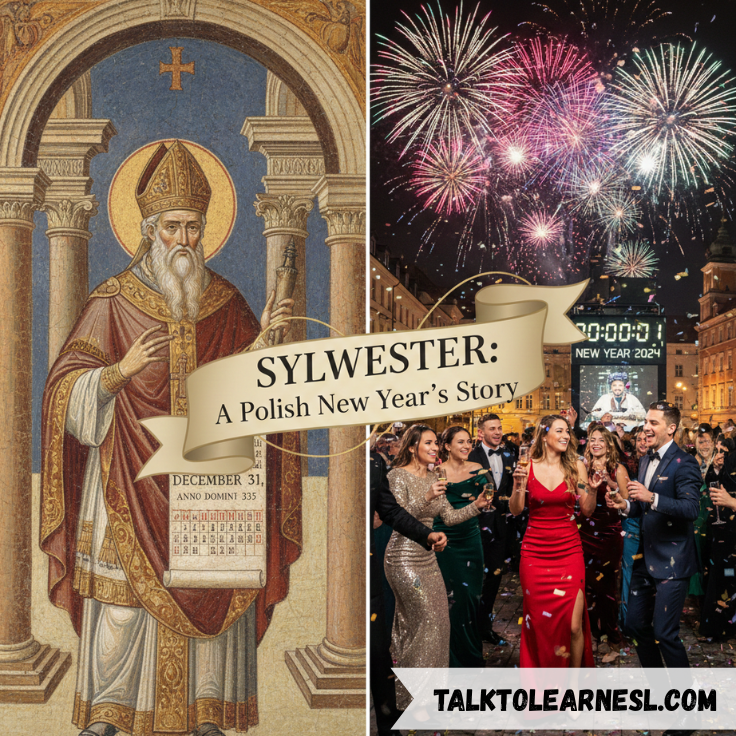
The Curious Story of Saint Sylvester and Poland’s New Year’s Eve “Sylwester”
Have you ever wondered why in Poland New Year’s Eve is called Sylwester? It sounds like a person’s name, and in fact, it is! But this story is not just about a name , it’s about time, tradition, and a very old connection between history and modern celebrations.
Saint Sylvester, A Man from Ancient Rome
Long, long ago, almost 1,700 years ago, there was a man named Sylvester. He lived in Rome, the capital of the Roman Empire, and became a very important religious leader. Sylvester was the bishop of Rome, which means he was one of the most important leaders of the early Christian Church. He led the Church from the year 314 until his death on December 31, 335. That means he died on the very last day of the year! For this reason, the Catholic Church set December 31st as his feast day, a special day in the church calendar to remember him. In church tradition, this day is called Saint Sylvester’s Day.
Name Days and Why People in Poland Say “Sylwester”
In Poland (and many European countries), every day of the year is the “name day” of a saint. Polish people often celebrate their name day, imieniny, like a birthday! So when December 31st came to be the feast day of Saint Sylvester, that date became known simply as “Sylwester” in everyday speech. Today when a Pole says Sylwester, they don’t mean just a person, they mean New Year’s Eve! It’s the night when we say goodbye to the old year and welcome the new one. This is not only true in Poland. Some other European languages also use Silvester/Sylvester for the last day of the year because the saint’s feast day becomes the name of the holiday, even if people don’t think about the saint when they celebrate.
How People Celebrate “Sylwester” in Poland
Polish traditions for Sylwester are big and joyful. Balls and parties. Many cities host large formal parties called bal sylwestrowy. In Warsaw or small towns like Gołub-Dobrzyń, people dress up, eat, and dance the night away. Some balls even start with a polonaise, a traditional elegant dance! At midnight, everyone drinks champagne (szampan) and makes a toast to the New Year. People wish each other happiness and good luck. Fireworks light up the sky, and many groups celebrate outdoors together. Often, people travel to the mountains or big cities to spend Sylwester with friends.
Some Polish traditions are very old, and some came from different times in history, like celebrations in the old Polish Parliament during the communist years, when people danced even though Christmas had religious meaning and was less public.
A Fun Connection Between Old and New
So even though today Sylwester in Poland means parties, music, dancing, food, and fireworks, it originally comes from a real historical figure, Saint Sylvester, who died on December 31st in year 335. In a way, we are sharing a moment with history: the last day of one year and the first moment of the next, connected by time, tradition, and celebration.

Sylwester – Vocabulary List
Time & Dates
- New Year’s Eve – the last day of the year (31 December)
- midnight – 12:00 at night
- feast day – a special day to remember a saint
- tradition – something people do again and again over many years
Religion & History
- saint – a very important and respected person in the Christian Church
- bishop – a high leader in the Church
- Roman Empire – a large empire in Europe many years ago
- Church – the Christian religious organization
Celebrations & Social Life
- celebrate – to do something special for a holiday or event
- celebration – a party or special event
- ball – a formal party with music and dancing
- social gathering – people meeting to spend time together
- toast – when people raise glasses and wish good things
Food & Drink
- champagne – a special sparkling drink, often for celebrations
- sparkling – with bubbles
- bubbly – another word for a drink with bubbles
Entertainment & Fun
- fireworks – colorful lights and sounds in the sky
- dance – to move your body to music
- music – sounds people enjoy listening to
Useful Verbs
- wish – to say you hope good things happen
- welcome – to greet something new
- connect – to link or join things together
- remember – to think about something from the past
Opinion & Description Words
- popular – liked by many people
- traditional – part of old customs
- joyful – full of happiness
- special – important or different from normal days




-
-
1 month
Tagged culture, europe, Middle East