
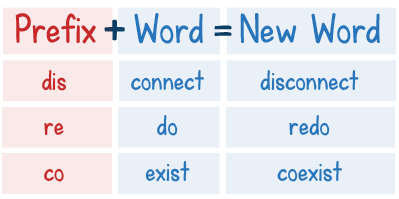
Prefixes are a group of letters added to the beginning of a word to change its meaning. Understanding how prefixes work can help you expand your vocabulary and improve your comprehension of English. When you know the meaning of a prefix, you can often make an educated guess about the meaning of unfamiliar words.
Let’s look at some of the most common prefixes in English and how they change the meaning of words.
1. Un-
- Meaning: Not, opposite of
- Examples:
- Unhappy: Not happy
- Undo: Reverse an action
- This prefix creates negative forms of adjectives, verbs, and even some nouns. For example, “unhappy” means “not happy,” and “undo” means “to reverse what was done.”
2. Re-
- Meaning: Again
- Examples:
- Replay: Play again
- Rewrite: Write again
- The prefix “re-” suggests repetition. When you “replay” something, you play it again. Similarly, to “rewrite” means to write again.
3. Dis-
- Meaning: Not, opposite of
- Examples:
- Disagree: Not agree
- Dislike: Not like
- This prefix indicates a negative or opposite action or state. If you “disagree,” you do not agree. To “dislike” something means you don’t like it.
4. In-/Im-/Il-/Ir-
- Meaning: Not
- Examples:
- Inactive: Not active
- Impossible: Not possible
- Illegal: Not legal
- Irregular: Not regular
- The prefixes “in-,” “im-,” “il-,” and “ir-” all mean “not,” but their forms change depending on the word they are attached to. For instance, “impossible” means “not possible,” while “irregular” means “not regular.”
5. Pre-
- Meaning: Before
- Examples:
- Preheat: Heat before
- Preview: View before
- The prefix “pre-” means before in time or order. When you “preheat” an oven, you heat it before cooking. A “preview” is something you see before the full presentation.
6. Mis-
- Meaning: Wrongly
- Examples:
- Misunderstand: Understand wrongly
- Misplace: Place wrongly
- This prefix suggests a mistake or wrong action. If you “misunderstand” something, you understand it incorrectly. To “misplace” something means to put it in the wrong place.
7. Over-
- Meaning: Too much
- Examples:
- Overcook: Cook too much
- Overwork: Work too much
- “Over-” implies excess or too much. If you “overcook” food, you cook it for too long. To “overwork” is to work too hard or too much.
8. Sub-
- Meaning: Under, below
- Examples:
- Submarine: Underwater vessel
- Substandard: Below standard
- The prefix “sub-” refers to something beneath or lower in position. A “submarine” is a vehicle that goes underwater, while “substandard” means below the expected level of quality.
9. Inter-
- Meaning: Between, among
- Examples:
- International: Between nations
- Interact: Act among
- The prefix “inter-” suggests something that occurs between or among entities. “International” refers to relations between nations, while “interact” means to communicate or engage with others.
10. Trans-
- Meaning: Across
- Examples:
- Transport: Carry across
- Transcontinental: Across continents
- “Trans-” refers to something that moves or is carried across. For instance, “transport” is the act of moving goods from one place to another, while “transcontinental” means extending across continents.
11. Super-
- Meaning: Above, beyond
- Examples:
- Supernatural: Beyond natural
- Superimpose: Place above
- The prefix “super-” denotes something that is above or beyond. “Supernatural” refers to things beyond what is natural or explainable, and “superimpose” means to place something on top of another.
12. Anti-
- Meaning: Against
- Examples:
- Antisocial: Against social norms
- Antidote: Remedy against poison
- “Anti-” indicates opposition. For example, “antisocial” describes behavior that is against social interaction, while an “antidote” is something that works against a poison.
13. De-
- Meaning: Opposite, remove
- Examples:
- Defrost: Remove frost
- Decompose: Break down
- The prefix “de-” often means to remove or reverse. To “defrost” is to remove frost, and “decompose” refers to breaking down into parts.
14. Non-
- Meaning: Not
- Examples:
- Nonexistent: Not existing
- Nonstop: Without stopping
- The prefix “non-” is used to negate something or express its absence. “Nonexistent” means not existing, while “nonstop” means without a break.
15. Post-
- Meaning: After
- Examples:
- Postgraduate: After graduation
- Postpone: Delay until after
- The prefix “post-” refers to something occurring after a particular event. “Postgraduate” refers to studies pursued after graduation, while “postpone” means to delay something.
16. Bi-
- Meaning: Two
- Examples:
- Bilingual: Speaking two languages
- Bimonthly: Every two months
- The prefix “bi-” relates to the number two. For example, a “bilingual” person speaks two languages, and “bimonthly” means something happens every two months.
17. Tri-
- Meaning: Three
- Examples:
- Tricycle: A three-wheeled vehicle
- Triangle: A three-sided shape
- “Tri-” refers to the number three, as seen in “tricycle” (a three-wheeled vehicle) and “triangle” (a shape with three sides).
18. Auto-
- Meaning: Self
- Examples:
- Autograph: Self-signature
- Automatic: Self-operating
- The prefix “auto-” means self. An “autograph” is a self-written signature, and an “automatic” device operates by itself.
19. Multi-
- Meaning: Many
- Examples:
- Multicolored: Many colors
- Multitask: Do many tasks
- “Multi-” refers to many or multiple. “Multicolored” means having many colors, and “multitask” refers to performing many tasks at once.
Read This List Of Common Prefixes And Suffixes
Rules for Using Prefixes in English
Prefixes can greatly alter the meaning of a word, but it’s important to apply them correctly. Here are some rules and tips for using prefixes:
1. Spelling Changes with Prefixes
- Generally, adding a prefix does not change the spelling of the base word. For example, adding “un-” to “happy” gives you “unhappy.”
2. Hyphenation
- A hyphen is used with some prefixes to avoid confusion or when the prefix ends in the same vowel the root word begins with, like “re-elect” or “co-operate.” Hyphenation is also used to clarify meaning, as in “re-cover” (to cover again) versus “recover” (to get better).
3. Prefix-Root Word Agreement
- Ensure that the prefix logically fits with the root word. For example, while “misunderstand” makes sense (to understand wrongly), something like “misdrive” would not be a meaningful word.
Understanding prefixes is an essential part of expanding your English vocabulary. By recognizing how prefixes change the meaning of words, you can quickly grasp the meaning of unfamiliar words and improve your overall language skills.