
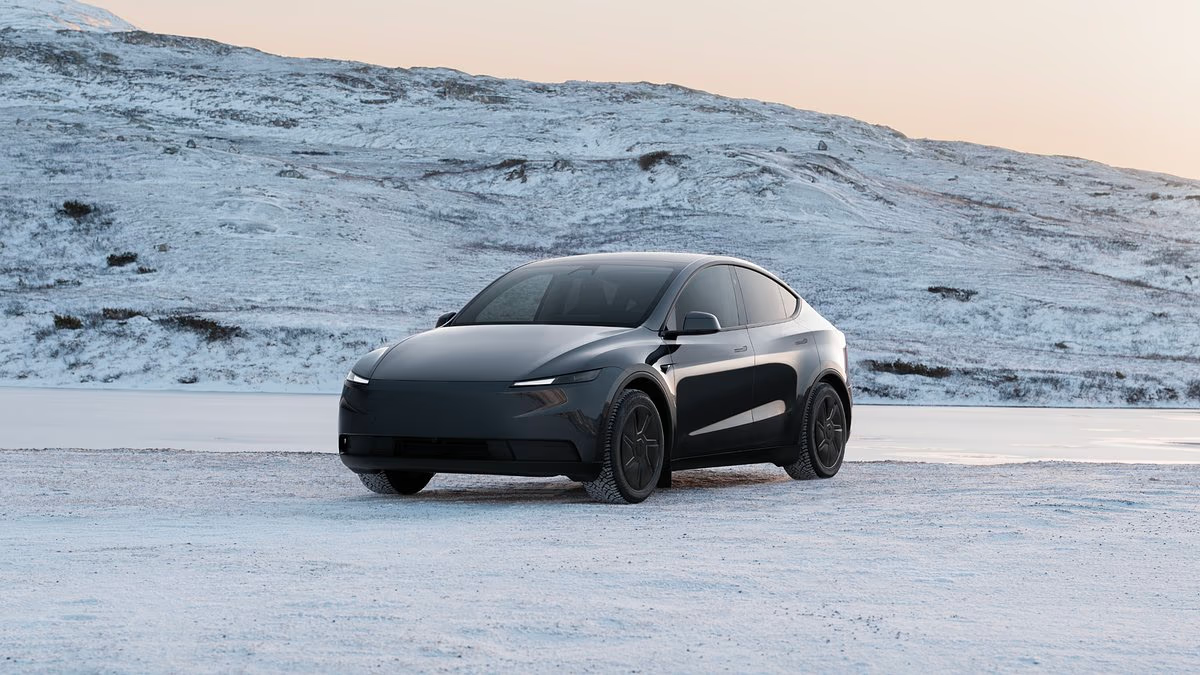
Tesla: Innovation, Controversy, and the Race to Electrify the World
Level: B2
Few companies create as much excitement and controversy as Tesla. Known for electric vehicles (EVs), self-driving technology, and bold leadership, Tesla has become one of the most discussed companies in the world.
But Tesla is not just a car company. It represents a larger transformation in energy, transportation, and climate politics. At the same time, it faces strong competition, public criticism, and big economic pressures.
Leading the Electric Vehicle Revolution
Tesla helped make electric vehicles popular. Before Tesla, many electric cars were small, slow, and not very attractive to buyers. Tesla changed this image by producing stylish, high-performance cars with long battery range.
In many countries, governments now encourage EVs to reduce carbon emissions. Because of this global shift toward clean energy, Tesla became extremely valuable in the stock market during the early 2020s.
However, the EV market is now far more competitive. Companies such as BYD (China), Volkswagen (Germany), and Ford (USA) are producing strong electric models. Tesla is no longer the only big name in EVs.
Slower Growth and Increased Competition
Recently, Tesla has faced slower sales growth in some regions. Price cuts have helped attract customers but also reduced profit margins.
In China, the world’s largest EV market, Tesla competes directly with local companies offering cheaper models. In Europe and the United States, economic uncertainty and higher interest rates have also affected car sales.
This shows that even innovative companies must respond quickly to changing market conditions.
Self-Driving Technology and AI
Tesla is investing heavily in artificial intelligence for autonomous driving. Its “Full Self-Driving” (FSD) system uses cameras and advanced software to assist drivers.
However, self-driving technology remains controversial. Some governments are carefully regulating autonomous features because of safety concerns. Accidents involving driver-assistance systems have raised public debates about responsibility and regulation.
The big question remains:
Will fully autonomous cars become normal in the next decade or will legal and technical problems slow progress?
Beyond Cars: Energy and Infrastructure
Tesla is also active in solar panels, battery storage systems, and large-scale energy solutions. Its Powerwall and Megapack batteries help store renewable energy from solar and wind power.
As many countries try to reduce dependence on fossil fuels, energy storage has become extremely important. Tesla aims to position itself not only as a car company but as a clean energy company.
If renewable energy expands globally, battery storage infrastructure may become one of Tesla’s most valuable business areas.
Leadership and Public Attention
Tesla’s public image is closely linked to its CEO, Elon Musk. His leadership style, public statements, and other business ventures have sometimes influenced Tesla’s stock price and reputation.
Some investors admire Musk’s bold vision and risk-taking. Others worry that controversy can distract from core business strategy.
This raises an interesting issue:
How much should a company depend on one strong personality?
Environmental Impact and Debate
Tesla presents itself as part of the climate solution. Electric cars reduce tailpipe emissions compared to gasoline vehicles.
However, critics argue that:
- Battery production requires mining rare materials.
- Manufacturing vehicles still creates emissions.
- EV charging systems depend on national electricity sources, which may not always be clean.
The environmental debate is therefore more complex than it first appears.
Why Tesla Matters
Tesla matters because it sits at the centre of three global changes:
- The transition to renewable energy
- The development of artificial intelligence in transport
- The transformation of global car markets
It shows how technology companies must constantly adapt, not only to innovation but also to politics, regulation, competition, and public opinion.
Whether Tesla will dominate the EV industry long-term remains uncertain. But its role in accelerating the shift toward electric mobility is undeniable.
Definitions
Autonomous – able to operate without human control
Regulation – official rules made by governments
Infrastructure – systems and structures needed for operation (roads, charging stations, power grids)
Profit margin – the difference between the cost of producing something and the money earned from selling it
Volatility – rapid and unpredictable change
Conversation Starters
Do you think electric cars are the future? Why or why not?
Should governments give financial support to EV buyers?
Is autonomous driving safe enough for public roads?
Can one CEO strongly influence a global company’s reputation?
Are electric vehicles truly environmentally friendly?
How will competition affect Tesla’s future?
Would you buy an electric car? What would influence your decision?




-
-
2 months
Tagged Business, fashion, lifestyle